Subtotal D0.00


Email : 211
From Teaching-only Culture to Teaching-led, Research-active UTG
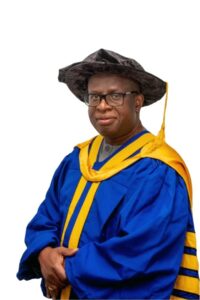
By Sanna Camara
The graduation ceremony of the Gambia’s main public university over the weekend was not just colorful, it was an opportunity for evaluation of a three-year performance of the Vice Chancellor, Professor Herbert Robinson: this is the 18th Convocation Ceremony, and the Class of 2025 stands as the largest graduating cohort in the history of the university. Some 1,633 graduands—893 men and 740 women – were conferred degrees in various fields, and the new Faraba Banta Campus – estimated 45 kilometers distance by road – was witnessing its third of such a ceremony.
Besides the president presiding over the ceremony as the Chancellor, the event attracted several other high profile international guests: Dr. Akinwumi Adesina, former President of the African Development Bank, Professor Daouda Ngom, the Honorable Minister of Higher Education, Research, Science and Innovation of Senegal; among others. In their presence and before God, the VC announced that the national institution is moving from a teaching-only culture to a teaching-led, research-active, service-oriented institution.
This, for the students and their lecturers, means that research work becomes integral part of their academic work, becoming a requirement for graduation at any level or course of the university. The initiative was based on a performance template – the Annual Performance Evaluation – aligned to the core mandate of the university, to ensure that academic outputs are driven by its strategic goals.
“The finalization will mark a structural shift in performance management, formalizing time for generating additional income through research, enterprise, and community service, and moving UTG from a teaching-only culture to a teaching-led, research-active, service-oriented institution,” the vice chancellor said.
The model of teaching-only culture has, in the past, brought lots of criticism to the University’s model of learning, raising questions about competencies of some of its graduates in delivering knowledge for the society’s needs in the 21st Century. This is why when he took over as VC, the renowned academic giant, having crisscrossed major higher institutions of learning from the UK to the US and Africa, moved swiftly to introduce this newer model of learning.
Resilience and Innovation
“When I assumed office in January 2022,” he recalled at the ceremony; “the University faced serious constraints: inadequate space, limited teaching capacity, staffing gaps, financial pressures, and weak stakeholder engagement,” he outlined, adding to the list issues of rising wage bills that further strained operations.
“Yet,” he added, “we responded with resilience and innovation,” prof Robinson said.
“We chose a path of reform and transformation. We pledged that our Quality-First agenda would drive this change, anchored on the six strategic priorities (The 6S),” he said, explaining that these priorities, aligned with the University’s vision, the goals of the Ministry of Higher Education, Research, Science and Technology (MoHERST), and the Refocused National Development Plan (RNDP), became the framework for reform.
They guided decisions and ensured that scarce resources were directed to the most critical areas of development.
As a result, graduation output rose sharply. Between 2022 and 2024: UTG graduated approximately 3,860 students, averaging 1,286 per year, compared with a historical average of 440 per year between 2004 and 2021.
Notable achievements in 2025 included the re-accreditation of the medical program (MB ChB) for four years and the accreditation of the dental program (BDS) for two years.
Hence to sustain this momentum, VC Robinson said the UTG adopted “a clear framework for improving quality of teaching and learning to enhance student experience.” Among these are:
- Establishing a Center for Teaching and Learning for continuous professional development, following the successful pedagogy course led by USA Fulbright Scholar Prof. Kabba Colley.
- Expanding problem-based learning and case studies to strengthen engagement and deepen analytical and practical skills.
- Leveraging technology for efficiency and to improve learning outcomes.
The research model developed and rolled out by the University was aimed at generating solutions to national and regional challenges through research and consultancy; and remains a strategic goal of the UTG.
“Over the past four years, we have expanded our research capacity, fostered interdisciplinary collaboration, and mobilized resources of over GMD 300 million to build a sustainable research culture,” said the VC, also revealing that between 2022 and 2025, publication volume of the university grew considerably, with emerging strengths in health, humanities, and sciences.
“Staff publications have increased significantly from an average of 100 in 2022, 2023, and 2024 to almost double in 2025,” he further revealed.
“Our research focused on critical national issues such as climate change, renewable energy, land use, food and nutrition, water quality, and broader themes of health, youth employment, sustainable development, and policymaking,” he said, explaining that these outputs have enhanced UTG’s external visibility and relevance.
Sustainable Financing
The VC also explained that quality teaching, research, innovation, and public service depend on adequate and predictable financing, announcing that the. UTG has established itself as a credible partner, generating over GMD 200 million in research and consultancy income from 2022 to 2024 through collaborations, thus reducing reliance on government funding.
The CIFAL training programs, a partnership program of the UNITAR launched in 2023, contributed more than GMD 26 million in 2024/25, while in 2025 the University secured five new project awards worth GMD 70 million, alongside the Qatar University Project valued at USD 305,255 (about GMD 22 million).
He also said that Endowment Fund Policy has also been validated and plans are at advanced stage to establish the UTG Enterprise Unit to advance proposals for infrastructure and commercial projects at Faraba Campus.
