Subtotal D0.00


Email : 413
By Adama Sanyang
Musolula Gardino is not the first cooperative women’s horticultural project in The Gambia. Neither is it the first in the village. It follows on several others in the past decades of the history of this small community of Boraba – some 300 kilometers from Banjul, located on te south banks of the River Gambia. The main difference between Musolula Gardino and its predecessor horticultural projects is that it is not designed in fancy agricultural offices in Banjul for donors to fund. Rather, it is home grown: conceived, nurtured and sold to NGOs to realise its aims.
It grew from a small group women’s social gathering under a shed in Jobarteh Kunda – a compound where a son of the household, Sainey Jobarteh, who, like his father, married a German woman by the name Bente. Her name is even problematic for local women to pronounce, and therefore likened it to a closest Mandinka word, benteng (a raised sitting platform, usually in big households or village squares). Bente would travel to Gambia on holidays each year with her husband and little son, Musa, to spend time in the village, becoming one of the favourite moments for the couple who reside in the cities of Europe.
Members of this group did not lack knowledge or skills to grow their own food. Rather, they lacked a sustainable approach that ensures their agricultural produce are properly stored, processed and sold at a scale that brings income for families, create a micro-finance savings for them, and operate their own cooperative based on mutual benefits and accountability. Sarata Jobarteh, one of Bente’s multiple mothers-in-law, having been married in the village as an educated housewife, helps coordinate the group through records keeping and basic accounting.
In the past, they cultivated their own foods from the rice fields and backyards of the respective compounds. To do it at a bigger scale, they required the support of able-body men, their husbands, uncles, sons and brothers in the community and beyond.
“When we ask the men to do the garden fencing for us, they ask for payment – from three to five thousand Gambian Dalasi, depending on the size of the garden,” Sarata explained, referring to sticks cut from branches of trees from nearby community forests. These are trimmed, erected in lined-up holes, bound together using strings woven from tree backs to make such fences. They can hardly survive an entire rainy season or the next one. Yet, it prevents both wildlife and livestock intrusions. The costs may out-match the total profits women make in each harvesting season. So a different fence, a more lasting, if not permanent one is required.
It was through their usual afternoon lunch gatherings that the women played with the idea of reviving a garden. Bente, who was on a vacation in the village, was among the gathering. She bought into it and they discussed their main challenges which resulted in failure of the previous gardens. Having gained NGO work experience in different foreign countries from Germany, Bente would add her knowledge, her family connections in Germany to help the women raise needed funds; private contributions came in from family, friends and like-minded NGOs to support individual contributions that the women were already doing in the village. Among them is the Rapunzel One World Foundation and EWS Sonnencent based in Germany. They would be invaluable partners to Musolula Gardino in establishing their own garden.
Next, they required a landed space for it. In typical Gambian communities, women do not own lands. Lands are held under centuries-old customary laws on behalf of families and clans by the men. But women can be granted access to it, yet owning one is a different ball-game. So, they went to see the village chief, Alkalo Mr. Ansumana Danso, who granted them an acre outside the village, between the old community garden and the cemetery.
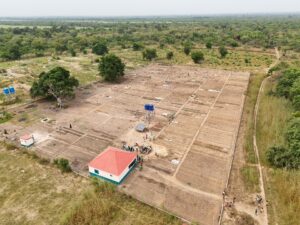
The project kicked off, first through organisation. Village women were called to a meeting to formalise the idea and register membership. Musolula Gardino was the association they registered as local partner of the international body, Nyodeema (Mandinka for self-help) Foundation. They would pay member dues, fully participate in works needed, such as land clearing, fencing, supporting contractors from brick laying to structural works by carrying blocks, pushing wheel-barrows and cooking for workers. Within a year, a perimeter fence was erected, a borehole sunk and equipped with water pump, an overhead tank, plus a storage room and toilets.
Toilets were fitted with showers and served as changing rooms for women to clean up after work. Agricultural extension workerss were hired to train the women on sustainable methods of a 100-percent organic horticulture production.
“Our aim is to work with nature rather than against it, using farming methods that protect soil fertility, biodiversity, and water resources in the long term,” Bente told us in an exchange following the launch of the first ever horticultural cold store in the region, meant for the garden in Boraba.
Members were taught that organic farming is essential for strengthening food security in a sustainable way, particularly in rural communities that are highly dependent on natural resources. By avoiding chemical fertilizers and pesticides, organic agriculture can help maintain healthy soils, reduces environmental degradation, and support resilient food systems that can better withstand climate-related challenges. It can contribute directly to the production of healthy, nutritious food for families, improving household nutrition and long-term well-being.
“Through Musolula Gardino, we therefore combine food security, environmental protection, and community empowerment in a holistic and sustainable way,” Bente explained.
In the project, no chemical fertilizer is allowed, says Jawo, one of agricultural extension workers from regional agricultural hub of the region, Sapu. “We train them to make organic compost, insecticides and herbicides from products readily available to them,” he added.
“Thanks to this project, women can now make honey on their own before men will produce these products and sell it to women…,” Sarjo Saidy, the president of the Nyodeema association, said beaming with a smile of economic empowerment brought by the project. The villagers allowed them access to the community forest just further from the garden towards the river to start beekeeping. Through training-of-trainers approach, women identify each other’s strengths in specific fields and assign responsibilities based on those.
“During the training on honey production, I was able to identify the bee queen from the rest of the hive,” she said, noting that such knowledge is new thanks to working with Musolula Gardino. Now, they even make honey on their own.
From productions, they are now focused on preservation through storage. “I am still selling the pepper I harvested three days ago and it is still fresh. This is thanks to the organic inputs during our productions. Chemicals would have spoiled it within days after harvest,” said Sarjo.
These have brought real freedom to women, by becoming less dependent on men for income and better family nutrition. Already, women are smiling to their garden each evening and each morning, to work for themselves, at their own pace. Fresh horticultural produces are available in the village throughout the year, which brings the matter of storage as a next challenge.
“These past years, we saw its impact during the Ramadan,” said Kunkung Jamba, president of village women and a member of the Musolula Gardino.
She is referring to the Muslim holy month of fast, when families spend on their best meals each day to break their fast, ending in a lavish feast. “I did not see any woman cry or feel worried for lacking ingredients to prepare family meals. Ramadans are costly, yet we cruised through it easily these past years,” she explained.
Once they harvest, the produces are stored in the solar-powered cold store built next to the new village market that the village men started to build almost ten years ago and still unable to complete. For now, they travel to nearby weekly markets to sell. That income helps ease their everyday problems.
“We are happy about this cold store, because whenever we sell our goods and there are leftovers, we easily keep them in the cold store for weeks and months without perishing,” Mrs Jamba added.
Now, they are inviting other women from nearby villages to take advantage of the success story of Musolula Gardino and use the cold store to keep their produce for a minimal fee.
From a garden to honey production and now a cold store – it has been a quiet revolution that is not using arms against hunger or against the promise of politicians. Rather, it is a way of empowering them with life skills and means to be less dependent, to care for families and themselves. That has been the goal of Musolula Gardino.
