Subtotal D0.00


Email : 187
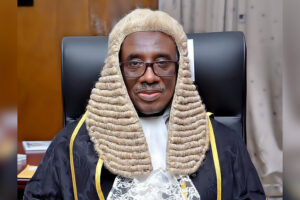
By Sanna Camara
The Chief Justice of The Gambia, Hassan B. Jallow has said with pride the exemplary leadership marks that the Gambia’s first president left on the country, saying he “genuinely won” all general elections contested as a show of high approval of his leadership by the population.
The Chief Justice delivered a 23-page, almost one-hour lecture to a hall-packed audience around the theme of Sir Dawda Kairaba Jawara’s legacy he was the guest speaker of Kairaba Conservation and Leadership Organisations (KAIRACLO) annual public lecture held in Banjul around the past New Year’s break.
He explained that Sir Dawda had to, many a time, stand his ground and resist local pressure for a different and more retrograde] governance] approach which would have led The Gambia in a different and backward direction.
“Yet we know that it was not always easy for Sir Dawda to instil the democratic culture in The Gambia,” he said.
Despite a majority in parliament, he said the leader “resisted pressures” from the party that would have made him turn Gambia into a one-party state. Neither did he yield to pressures when he failed to secure the required votes to make The Gambia a Republic in 1970.
“As the ruling party continued to defeat the opposition parties in one general election after another, Sir Dawda again resisted pressures from the party to declare The Gambia a one-party state. He continued to resist pressure to make appointments to senior positions in the public service on the basis of tribe and religion,” Jallow added.
Chief Justice Jallow who served as Attorney General and Minister of Justice from June 1984 to July 1994, said his lecture focuses on Sir Dawda’s commitment, contribution and legacy in the promotion and the maintenance of good governance. And to speak to the centred relevance of his legacy in the resolution of the challenges the country currently faces.
“I do so from the vantage point not only of a citizen and resident of The Gambia who, like many others, benefitted immensely from his work in this field. But also, as his Attorney General and Minister of Justice and thus his chief legal adviser from June 1984 to July 1994,” Jallow explained, having worked closely with, and observed at first-hand Sir Dawda’s work in the field of governance.
Throughout the journey of nation building, he said that Sir Dawda was eventually vindicated for espousing the principles of inclusivity, respect for human rights, and good governance practices at a time that one party systems were popular among post-independent African states.
“The country eventually in acknowledgment of the rule of law endorsed by referendum his proposal for the Gambia to become a Republic, which it did in 1970. The one-party system of governance becomes gradually discredited and abandoned, in favour of the political pluralism which Sir Dawda had championed and stood by. The Gambia’s public service eventually becomes an excellent model for professionalism and efficiency in our region,” he said.
Also in his acceptance speech at the PPP congress in Mansakonko in December 1991 of the nomination for the post of Party Secretary General, Sir Dawda took the opportunity to announce that whilst accepting that nomination, he had decided however not to accept the nomination for Presidential candidate when his then current term expired on the 11th of April 1992 – a decision that did not sit well with party members and indeed with many Gambians.
In the end, under considerable pressure from within and outside the party and government, in The Gambia and abroad, the Chief Justice recalled that Jawara had to withdraw the decision not to contest the 1992 presidential election as the PPP candidate.
He described this as “the single instance where the party had acted against the wishes of Sir Dawda.
From Independence to Economic Reliance
Chief Justice Jallow, born 14th August 1951, said he witnessed the hoisting for the first time of The Gambia National Flag in its Red, White, Blue, White, Green colours; witnessed and heard the playing at a public official ceremony of The Gambia National Anthem for the first time; witnessed the handing over of the instruments of independence to the then Prime Minister Sir Dawda Kairaba Jawara by the Duke of Kent on behalf of Her Majesty Queen Elizabeth the Second (she was to remain the Head of State of The Gambia until 1970 when The Gambia attained Republican status) – described the 18th February 1965 as an exciting and momentous occasion.
“But the task ahead was also daunting and full of challenges. My own experience was undoubtedly a reflection of the life of the vast majority of the population at the time,” he said.
As a descendant of rural Gambia (he was born and raised in Bansang) in what was then the McCarthy Island Division (MID), CJ gave a glimpse into life in pre-independnce Gambia when the PPP took over, describing his town as a relatively “developed” locality compared to others in the rest of the country
He said he grew up and lived for long without the benefit of simple essentials like running water or electricity; no telephones; none of what was then a luxury and now a common place – no radio, no Television, no nearby High School – the only such school in the entire provinces was Armitage School in the then George Town – that could not admit or accommodate all those who wished to pursue High School education.
So, like many others, Banjul the capital, was the only available alternative – and traveling from rural Bansang by road was nothing near adventurous. “In those days, it took at least two days to travel by lorry on what were essentially dirt-roads from Bansang to Banjul; the boat trip – on either the MV Fulladu or the MV Lady Wright usually took two nights and three days over the same distance,” he recounted
“We walked barefoot, including to school and back, dashing from one tree shade to another, under the hot sun, to avoid the burning sands of the route,” he explained.
Life in Banjul then…
Life in Banjul at the time, was only “marginally better,” he said, with poor accommodation and poor sanitary conditions and undeveloped infrastructure. He also remembers well that much of their reading and studies in the evening had to be conducted under candlelight or hurricane lamps.
The veranda of the General Post Office (GPO) on the then Wellington street in Banjul – and other streetlamps – often provided a source of lighting for many students who gathered there at night to continue their studies.
The road network in the urban area was equally very limited. The tarred roads essentially comprised the stretches from Banjul to Sting Corner, the old Cape Road in Bakau; Atlantic Road from Bakau to Fajara, Pipeline; from Fajara to Westfield and from Westfield to Sting Corner. And back to Banjul!
“That was it! Life was undoubtedly difficult and full of challenges at the time,” he said, expressing believe that such information may benefit younger generation who were unborn before independence in 1965.
Three Decades of Independence Rule: best economies, good governance scores
However, within three decades of the PPP rule, the CJ said that the results of two respectable international surveys released shortly before the end of Sir Dawda’s tenure in 1994, best demonstrated the legacy he bequeathed to The Gambia: one included The Gambia amongst the seven best performing economies in Africa. The other gave The Gambia the highest possible score in the domain of good governance and respect for human rights.
“That was indeed a strong and laudable legacy he left for the nation,” the CJ said of Sir Dawda, maintaining that as a country, The Gambia has every reason to celebrate the legacy, work and achievements of Sir Dawda as a life well spent and fully devoted to the community.
