Subtotal D0.00


Email : 244
By Sanna Camara
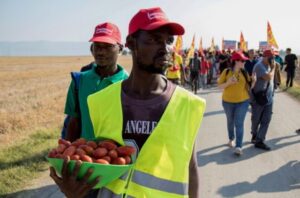
This latest death – second since January this year – of a Gambian migrant farm worker in Italy has been ruled as suicide. Alagie Singhateh, a 29-year-old was found submerged in mud among shacks, following a heavy downpour in the shantytown of Torretta Antonacci, in the province of Foggia. In January, another farmworker from The Gambia, reportedly died “of cold and hardship” – he was just 38 years old.
Agricultural and trade unionists in Italy such as CGIL criticized the “unacceptable” living conditions of thousands of undocumented migrants forced to live in the ghettos of the province of Foggia. Authorities meanwhile are facing criticism over the failure to use allocated funds to clear the slums and establish proper housing conditions, describing it as “unacceptable living conditions.”
“There is well-founded suspicion that, the right-wing government simply does not care about the lives — and deaths — of thousands of agricultural workers forced to live in conditions that can only be described as a crisis. Their only crime, evidently, is being foreign.”
The Gambian migrant population in Italy is estimated to be between 20 to 25, 000, almost 2,000 of which are minors that arrived in Italy unaccompanied by adults. Although many of them blame economic hardship and limited opportunities in The Gambia, Italy’s position as a primary entry point into Europe through the Mediterranean Sea, plus demand for labour in agriculture, construction, and domestic work have made a first choice for many departing the country.
“A fragile territory inhabited by a trampled humanity”
Antonio La Fortuna, secretary general of Fai Cisl Puglia, and Donato Di Lella, secretary general of Fai Cisl Foggia, have both condemned Mamadou’s recent death, who media reports said, “hanged himself” in the shantytown.
It is not the first such death in recent years: in 2024, an Indian farmworker was left to die by on the roadside following an accident in which his arm was sliced off by a machine. His employer abandoned him there, sparking public outrage in Italy.
The shantytown of Torretta Antonacci, in the province of Foggia, has become the backdrop of this latest tragedy. Rights groups called it “yet another political death” in Italy and Europe; and of betrayed rights.
“To hang yourself at [age of] 29 in a shack inside a ghetto is an act of indictment against legislation that criminalises those who migrate,” said Matteo Bellegoni, head of the Migration Policy and Legality department at Flai, denouncing the condition of workers as “exploited” and victims of the caporalato system – a mafia network in Italy that recruits migrant workers—especially in agriculture—under exploitative conditions, involving extremely low wages, unsafe environments, and overcrowded housing.
These workers are often forced to live in rows of flooded containers. “The scenes broadcast by local television are dramatic: water up-to-the-knees; belongings piled up outside, bags hanging from any available hook, personal objects brought out in a desperate attempt to keep them dry.
“Many farmworkers spent the night outside, taking shelter in cars or in the few remaining dry corners,” eyewitnesses and media reports reveal.
Humanitarian Interventions
The next morning, Bishop of San Severo, Monsignor Giuseppe Mengoli, went to visit these slums, and interacted with migrant workers, who made requests and put forward proposals.
“We feel powerless, Bishop Mengoli said. “But faced with their demands, we believe a regularisation amnesty is necessary to guarantee their rights.”
Don Nazareno Galullo, director of the diocesan Migrantes office, who accompanied the bishop, remembers Alagie well: “Alagie came from Gambia and arrived in Italy ten years ago, landing at Lampedusa,” he said.
“Lately, he had been very low because he was afraid of not being able to obtain his residence permit again” – described as a common condition in the ghetto.
“They ask us to help them get out, but without residency, that’s difficult,” Don Galullo said. “And without residency, it’s almost impossible to have regular employment. They tell us: ‘you Italians exploit us and then make us live here’.”
Don Nazareno said Alagie’s last request was to ask for a pair of shoes. “He had asked me for shoes in size 45. We had found them, but too late…”
“The young man could not bear the degradation and exploitation any longer. Nobody knew where he had ended up,” Don Nazareno said.
And in the end, they found him in a tumbledown farmhouse, in the middle of the mud. Hanged.
Editor’s Note:
This story was originally reported in Italian language by Marco Birotini and Toni Mira for www.avvenire.it


